EXPERT REVIEWED
  FREE DELIVERY
  INSTALATION AVAILABLE
 Tigerflex Shiplap Apex Windowless Double Door Shed – Expert Review
First Added - November 28 2025
Last Updated - November 28 2025 - 0 Data Points Updated - 0 Data Points Added
Reviewed & curated by a panel of garden building experts. Using methodology 1.1
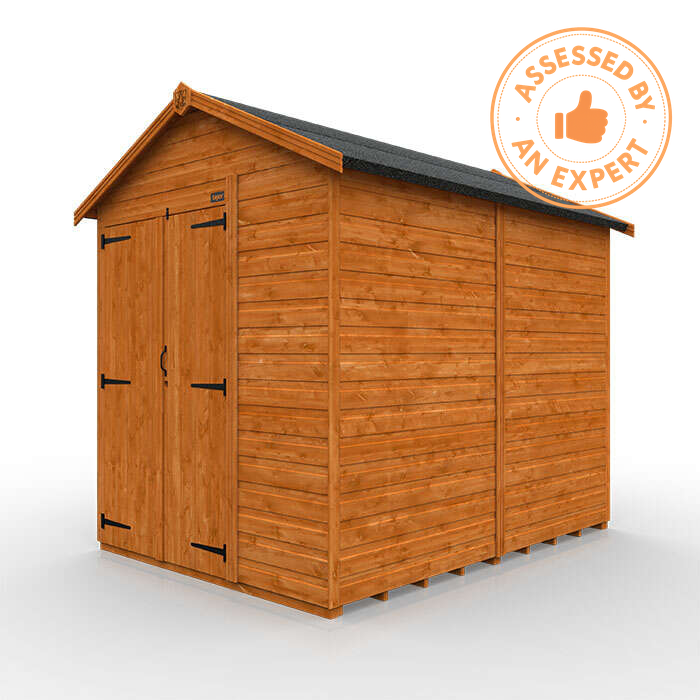
Product ID: tiger-sheds-tigerflex-shiplap-apex-windowless-double-door-shed
Size: Multiple sizes available
Merchants Checked: 10
TigerFlex® Shiplap Apex Double Door Windowless Shed Review
If you’ve already read our review of the TigerFlex Shiplap Apex Windowless Shed, you’ll know exactly what makes that model such a dependable, quietly impressive garden building. The double-door version is cut from the same timber — sometimes literally — and shares almost all of its DNA: the same 12mm shiplap tongue-and-groove cladding, the same 12mm tongue-and-groove roof and floor (with no OSB or sheet-board shortcuts), the same 28 × 44mm framing, the same modular TigerFlex layout, and the same reassuringly traditional apex silhouette. :contentReference[oaicite:0]{index=0}
So when you walk up to the double-door version for the first time, the shed feels familiar. But the moment you reach the front, the personality shifts. Because double doors don’t just give you a wider opening — they change the character of the entire building.
This review combines our real-world inspections of TigerFlex Apex sheds with the manufacturer’s technical data and assembly methodology — the boring-but-important stuff that reveals whether a shed is designed to last, and what actually matters for longevity.
At-a-glance: key facts (8×6 model)
- Internal size: 2300mm × 1662mm :contentReference[oaicite:2]{index=2}
- Internal ridge height: 2055mm :contentReference[oaicite:3]{index=3}
- Internal eaves height: 1810mm :contentReference[oaicite:4]{index=4}
- Door type: Double fully boarded tongue-and-groove :contentReference[oaicite:5]{index=5}
- Door size (each leaf): 1032mm × 1692mm :contentReference[oaicite:6]{index=6}
- Cladding / roof / floor: 12mm tongue-and-groove (no OSB) :contentReference[oaicite:7]{index=7}
- Roof covering: Black mineral felt :contentReference[oaicite:8]{index=8}
- Treatment: TigerSkin® Burnt Orange (water based) :contentReference[oaicite:9]{index=9}
- Weight (8×6): 221.19kg :contentReference[oaicite:10]{index=10}
The shared foundations: what’s identical across both models
Before we get into the double-door specifics, it’s worth establishing that the underlying build quality is exactly the same as the single-door version:
- 12mm shiplap tongue-and-groove cladding
- 12mm T&G roof and 12mm T&G floor — explicitly no OSB / solid sheet board
- 28 × 44mm rounded four-corner framing
- Black mineral felt
- TigerSkin® pre-treatment applied at the factory
- Modular TigerFlex panels (configured by you)
- British-made with FSC® timber
- 20-year Tiger Guarantee
All of that is straight from Tiger’s own technical sheet — and it matters, because it’s exactly the set of decisions that separates a “fine for a summer” shed from a “quietly keeps working for years” shed. :contentReference[oaicite:11]{index=11}
So structurally, you’re getting the same bones, the same weather performance, and the same longevity as the single-door TigerFlex. What changes, and changes meaningfully, is the front end — and the way you use the shed day to day.
First impressions: familiar TigerFlex quality, immediately more usable
Approaching this shed, everything feels exactly as expected from the TigerFlex Apex range. The boards are cleanly machined. The framing looks square. And when you get close and start looking at panel joins, you can see the “Flex” logic: it’s modular, designed to be carried through awkward access, and designed to let you configure the building around your garden rather than the other way round.
Tiger put it plainly: “The doors can go in any position, on any side.” That single sentence is one of the biggest real-world advantages of the TigerFlex system, because it means you can bias your opening to a path, a fence line, a corner, or an internal shelving plan.
On a windowless shed, that flexibility gets even more important because the doors are effectively your light source when you’re working at the threshold.
The doors — where everything becomes interesting
A wider opening… but narrower individual doors
Most people assume a double-door shed simply has two versions of the single large door. That is not the case here — and this is where Tiger’s design starts to feel clever.
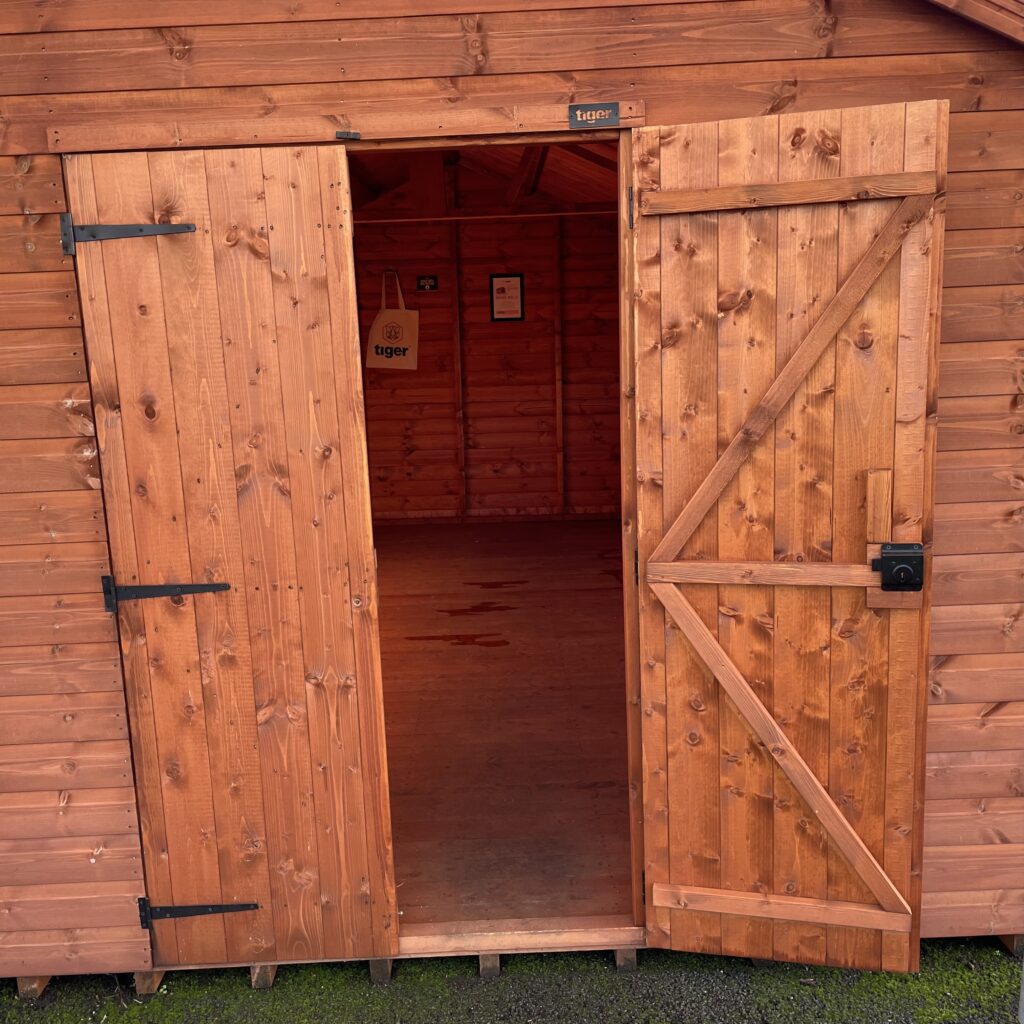
Each individual door in the double-door model is narrower than the single full-width door on the standard version. Tiger list each door leaf at 1032mm × 1692mm, and it’s that narrower profile that changes how the doors behave in the hand. :contentReference[oaicite:13]{index=13}
In simple terms:
- A narrower door flexes less.
- The bracing covers a higher percentage of the surface.
- Each hinge carries less weight and less leverage force.
So even though you gain a wider total opening, each leaf behaves like a stronger, more obedient component. On the TigerFlex double-door units we’ve inspected, the doors swing with a tight, confident movement — no twisting, no shudder — and they land squarely in their frame in a way many wide single doors simply don’t.
You get more access without the “double-door wobble” common in cheaper sheds.

The locking system — practical, familiar, and genuinely usable
Tiger list the locking setup as “Lock and Key + Turn Button”, which gives you a straightforward, everyday security arrangement without gimmicks. :contentReference[oaicite:14]{index=14}
In real use, the double-door layout typically works like this:
- The “passive” leaf is secured into place (so it behaves like part of the wall).
- The “active” leaf becomes your daily access door — and is the one you lock.
On a windowless shed — where security and privacy are often the main appeal — that’s exactly the behaviour you want: once locked, the front feels like a continuous barrier rather than two flimsy panels waiting to be prised.
But there is one security caveat (and it matters)
This is the one area where I always encourage an honest upgrade mindset, especially if you’re storing high-value kit:
Hinges are commonly fixed with standard external screws. A determined intruder could, in theory, remove fixings and attempt to lift a door off.
This isn’t unique to Tiger — it’s common across the shed market — but because double doors mean more hinges, it’s worth addressing. The good news is the fix is simple and inexpensive:
- Fit hinge bolts, or
- Use tamper-resistant security screws, or
- Add an internal security bar across the doors (Tiger’s own security-bar method is shown in their assembly guide). :contentReference[oaicite:15]{index=15}
Once you do that, the double-door model becomes extremely convincing as secure storage, because the doors are narrower, better braced, and tend to stay aligned.
Real-world use: where double doors are transformative
1) Moving large items becomes a pleasure
On the single-door shed, moving a mower can require a bit of choreography. On the double-door shed, you simply open both leaves and walk straight through.
This is where the combination of double doors and the TigerFlex “configured by you” system really shines: a wide opening is only useful if it’s in the right place — and with TigerFlex you can place it where it works best for access, storage flow, and garden layout. :contentReference[oaicite:16]{index=16}
Bikes go in straight and come out straight. Bulky furniture doesn’t need turning. Heavier items can be rolled in on a trolley rather than angled through a narrow doorway.
2) Better organisation inside
Because you can open the entire front, you’re not forced into an awkward “door corridor”. On an 8×6 with an internal size of 2300mm × 1662mm, that makes the space feel more usable than the numbers suggest. :contentReference[oaicite:17]{index=17}
You can load shelving at the back without contorting. You can reach corners more easily. And you’re more likely to keep the shed organised because access is frictionless — which sounds small, but it’s the difference between a shed you use and a shed you dread.
3) Ventilation is better, even without windows
Windowless sheds can get warm and stale. Double doors fix that quickly. Open the front wide and you get a proper flush of air — ideal after rainfall, during damp seasons, or if you store anything with fumes.
How it feels inside: floor, walls, roof
The floor: “proper boards” behaviour
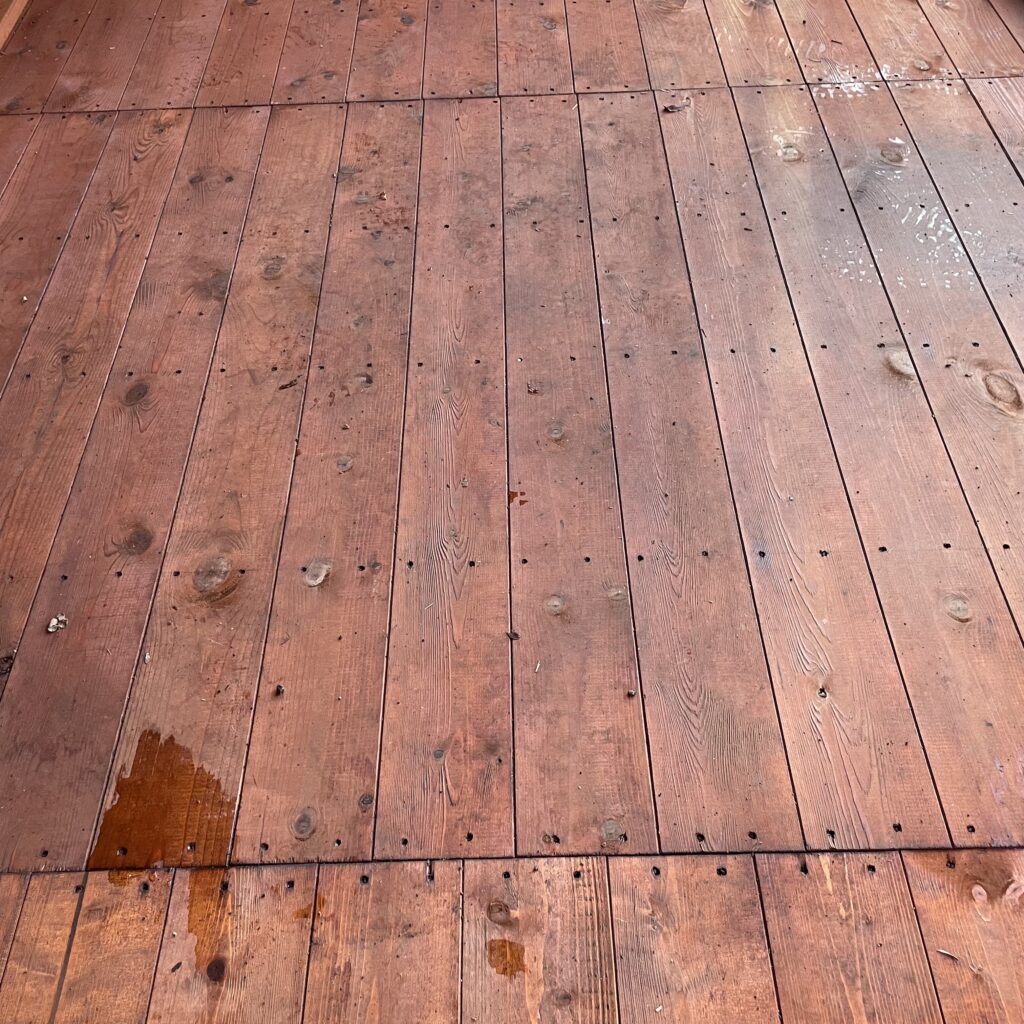
The first thing you notice on a well-built TigerFlex Apex is that the floor doesn’t “drum”. The technical sheet confirms a 12mm tongue-and-groove floor with no OSB, and that shows up instantly underfoot. :contentReference[oaicite:18]{index=18}
Stand centrally and you’ll get a small amount of controlled flex — timber buildings should move a little — but the feel is dense and confidence-inspiring, the sort of platform you’re happy to load with real weight.
The walls: modular panels, more bracing points
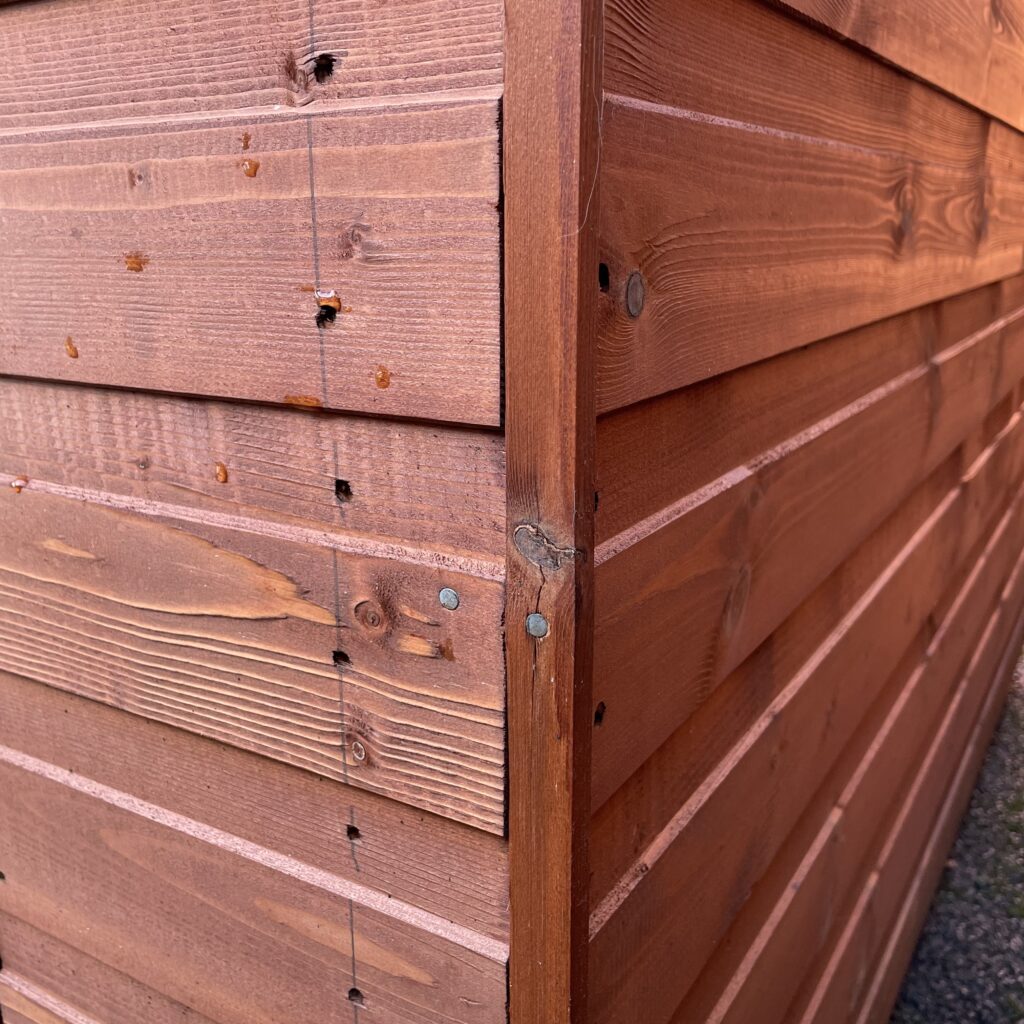
Because the shed uses modular panels, you effectively get more verticals and more bracing points along a wall run. In real terms, that often produces a wall that feels “locked together” rather than long and bow-prone. Lean into it and movement is modest and controlled — exactly what you want from 12mm shiplap tongue-and-groove cladding supported by 28 × 44mm framing. :contentReference[oaicite:19]{index=19}

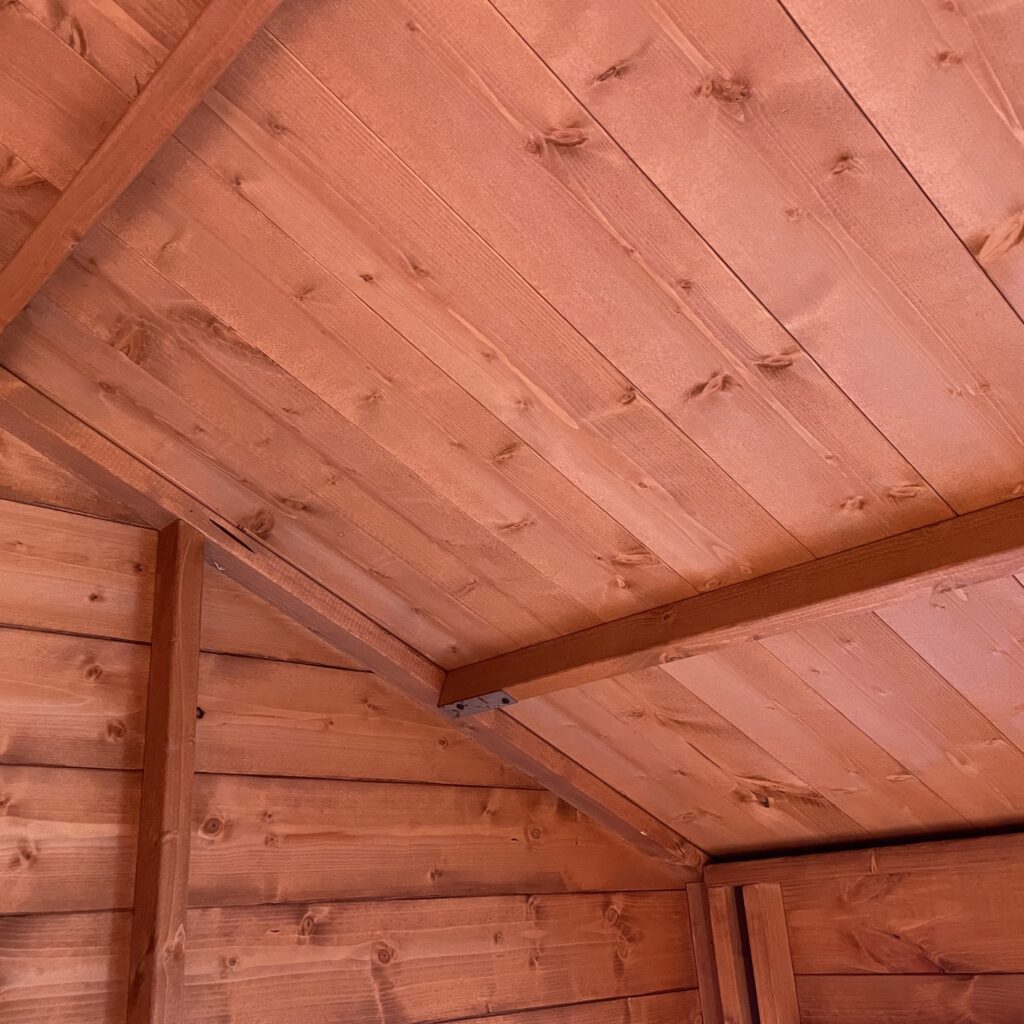
The roof: firm structure, then felted properly
The datasheet confirms a 12mm tongue-and-groove roof and black mineral felt. :contentReference[oaicite:20]{index=20}
The assembly guide is also very clear about how Tiger want the roof to be installed: make sure the overhang is even at both ends, keep everything square before you fix it, and then fit the felt with a sensible overhang. Their felt guidance is specific: leave around 75mm (3″) to fold down onto the roof purlin, and do not fold it underneath the roof — a small detail that helps prevent early water ingress and lifting edges in wind. :contentReference[oaicite:21]{index=21}
Assembly & base: where people win or lose
Most shed complaints come down to one thing: the base.
Tiger are refreshingly direct about it. The base must be firm and level to prevent distortion, and they specifically recommend:
- The base should be slightly smaller than the external measurement so the cladding overlaps it and creates a run-off for water. :contentReference[oaicite:22]{index=22}
- The floor should be at least 25mm above surrounding ground level to avoid flooding. :contentReference[oaicite:23]{index=23}
- Assembly should be done by two competent adults. :contentReference[oaicite:24]{index=24}
- They recommend aligning everything properly before fixing, and pre-drilling screw holes to reduce timber splitting. :contentReference[oaicite:25]{index=25}
Those are exactly the details that separate a shed that feels “tight and square” from one that develops door rub, roof misalignment, and gaps that were never the shed’s fault in the first place.
One extra practical detail that’s easy to miss: Tiger note that double doors are pre-fitted in the workshop, and they include an optional extra corner strip that can be trimmed and fitted as a door cover piece to close the central gap — just be careful not to cover the keyhole. :contentReference[oaicite:26]{index=26}
Maintenance & longevity: the treatment truth (and the guarantee)
The shed arrives with TigerSkin® pre-treatment, which gives a reassuring first layer of protection. But Tiger are also clear: to validate the guarantee and ensure longevity, it is essential that the building is treated with a suitable wood preserver or paint after assembly, both internally and externally. :contentReference[oaicite:27]{index=27}
That’s not a box-ticking exercise — it’s how you stop end grain drying out, joints opening, and water finding the weak points over multiple seasons. Do it properly, keep on top of annual care, and this is the kind of shed that’s designed to last.
Range-wide notes: how other sizes behave
Although the 8×6 is the sweet spot for balanced proportions, the TigerFlex Double Door Windowless Apex line spans several sizes — all using the same construction recipe. :contentReference[oaicite:28]{index=28}
- 4×4: internal 1150mm × 1062mm (compact tool store feel) :contentReference[oaicite:29]{index=29}
- 8×4: internal 2300mm × 1062mm (excellent for bikes and long-handled kit) :contentReference[oaicite:30]{index=30}
- 12×4: internal 3450mm × 1062mm (long corridor storage) :contentReference[oaicite:31]{index=31}
- 4×6: internal 1150mm × 1662mm (compact but very usable) :contentReference[oaicite:32]{index=32}
- 8×6: internal 2300mm × 1662mm (most balanced proportions) :contentReference[oaicite:33]{index=33}
- 12×6: internal 3450mm × 1662mm (mini-workshop volume) :contentReference[oaicite:34]{index=34}
Across the range, the windowless design keeps the interior private. The double doors give you the access and ventilation you need when you want it — and then the shed returns to being a secure store when the doors close.
Final verdict: the double-door version is the more versatile shed
If you read the single-door TigerFlex review, you already know Tiger have built a wonderfully competent, honestly crafted shed. The double-door version keeps all of that — the rigidity, the weather performance, the tight-grain timber, the “no OSB” build choices — and opens up the front in a way that makes the whole building more usable.
Choose the double-door model if:
- You move large items in and out
- You want genuinely easy access (and quick ventilation) from a windowless shed
- You prefer two lighter, stiffer doors over one heavy slab
- You’re happy to add a simple hinge-security upgrade if storing high-value items
Choose the single door if:
- You want the simplest possible interface
- You’re storing mostly compact items
- You don’t need wide “walk-through” access
Our verdict: once the small hinge security upgrade is applied (hinge bolts or tamper-resistant screws), the TigerFlex Shiplap Apex Double Door Windowless Shed becomes the more practical and more versatile choice for most modern gardens.
It’s everything the single-door model is — but with a front end that makes daily life noticeably easier.
A genuinely excellent shed.